The Fee Problem Nobody Talks About
Every creator platform advertises differently. Payhip says "free forever." Gumroad says "start selling in minutes." Creastor says "0% transaction fees." But what matters isn't the marketing — it's what you actually pay when real money flows through your store.
This comparison breaks down the true cost of each platform at real-world revenue levels, then examines features, limitations, and which platform genuinely fits different creator profiles.
The Fee Structures, Simplified
| Platform | Free Plan Fee | Paid Plan | Paid Plan Fee |
|---|---|---|---|
| Payhip | 5% per sale | $99/mo (Pro) | 0% |
| Gumroad | 10% per sale | None available | 10% (always) |
| Creastor | 5% per sale | $19/mo (Creator) / $39/mo (Pro) | 0% |
Gumroad has no paid plan that reduces fees. You pay 10% whether you make $100/month or $100,000/month. That's the most expensive fee structure in the creator platform space.
Payhip's free plan is competitive at 5%, but the only escape is a $99/month Pro plan — expensive for creators in the growth phase.
Creastor matches Payhip's 5% on free and offers 0% fees starting at $19/month.
Real-Money Impact at Every Revenue Level
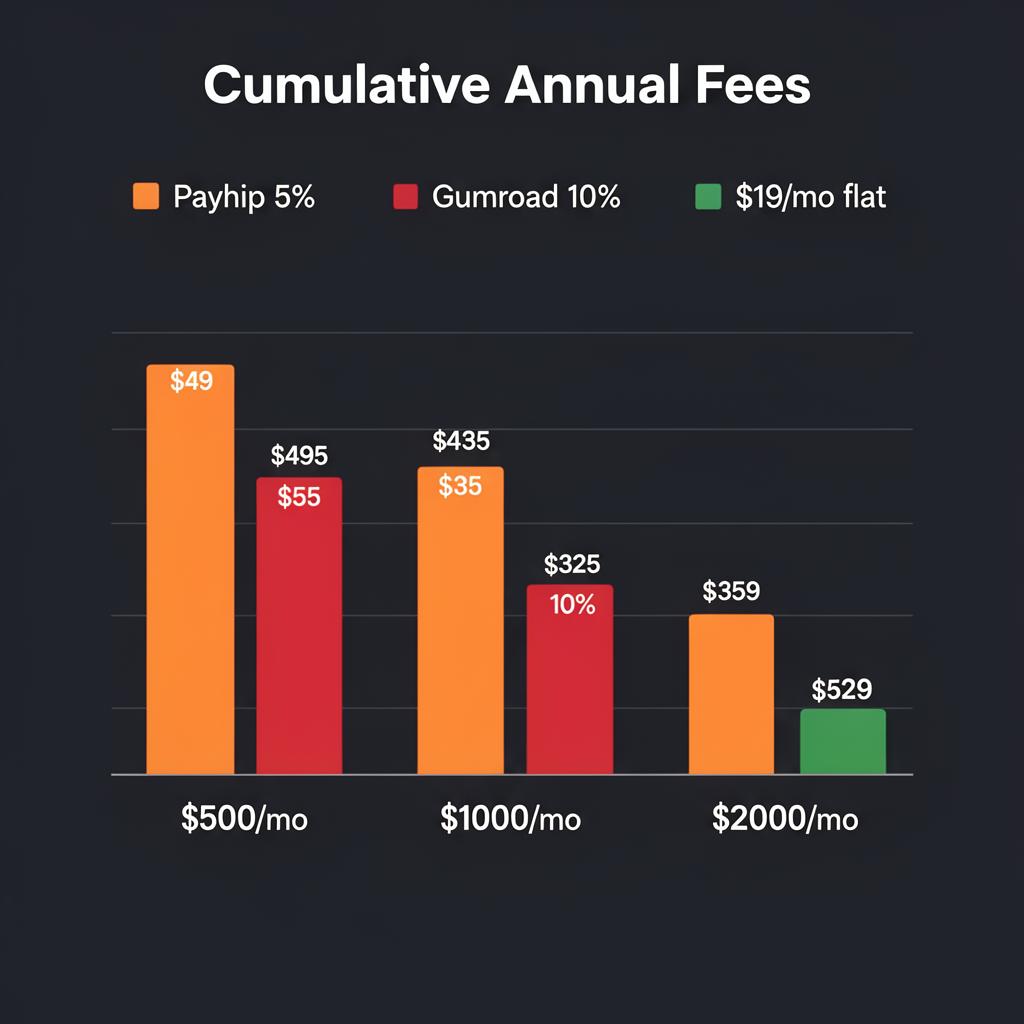
Let's calculate the actual platform cost (excluding payment processor fees, which are identical across platforms) at different revenue levels:
| Monthly Revenue | Payhip Free (5%) | Gumroad (10%) | Creastor Free (5%) | Creastor Creator ($19/mo, 0%) |
|---|---|---|---|---|
| $200 | $10 | $20 | $10 | $19 |
| $500 | $25 | $50 | $25 | $19 |
| $1,000 | $50 | $100 | $50 | $19 |
| $2,000 | $100 | $200 | $100 | $19 |
| $5,000 | $250 | $500 | $250 | $19 |
| $10,000 | $500 | $1,000 | $500 | $19 |
The pattern is clear:
Beyond Fees: Feature Comparison
Storefront and Sales Experience
Payhip: Basic store page with product grid. Clean but generic. No bio link optimization. Pages feel like traditional e-commerce, not social commerce.
Gumroad: Minimal profile page with product cards. The design is intentionally sparse. Discovery happens through Gumroad's marketplace, not your own branded experience.
Creastor: Purpose-built link-in-bio storefront with customizable templates, mobile-first checkout, and a shopping experience designed for social media traffic. Your store looks and feels like your brand.
Winner: Creastor — especially if your buyers come from social media.
SEO and Organic Discovery
Payhip: Minimal SEO infrastructure. Product pages lack structured data, proper meta tags, and semantic markup. Your products won't rank on Google.
Gumroad: Slightly better — Gumroad's marketplace has some SEO weight, and your profile page can appear in search results. But individual product SEO is limited.
Creastor: Full SEO optimization with JSON-LD structured data, semantic HTML, customizable meta descriptions, and indexable product pages. Your products can rank for buyer-intent keywords on Google.
Winner: Creastor — organic search traffic is free, sustainable, and compounds over time.
Email Marketing
Payhip: Email collection only. No built-in sequences or automation. Requires third-party integration (Mailchimp, ConvertKit, etc.) at additional cost.
Gumroad: Basic email functionality. You can email your customers, but automation is limited. No multi-step sequences or behavioral triggers.
Creastor: Native email marketing sequences with automated flows. Welcome sequences, post-purchase follow-ups, and launch emails — all from one dashboard.
Winner: Creastor — eliminates the need for a separate email marketing tool.
Course Hosting
Payhip: Basic course builder with video hosting, lesson organization, and student enrollment. Functional but lacks advanced LMS features.
Gumroad: No course builder. You can sell access to content, but there's no structured course experience with lessons, modules, or progress tracking.
Creastor: Full course builder with structured lessons, content modules, student progress tracking, and integrated checkout.
Winner: Tie between Payhip and Creastor for basic courses. Creastor edges ahead with better progress tracking.
International Selling
Payhip: Strongest here. Automatic EU VAT calculation, collection, and remittance. If you sell to European customers, this is a genuine advantage.
Gumroad: Handles international payments but VAT handling is limited compared to Payhip.
Creastor: International payments via Stripe. VAT handling is the creator's responsibility.
Winner: Payhip — for EU-focused sellers, this matters.
Who Should Choose Each Platform
Choose Payhip if:
Choose Gumroad if:
Choose Creastor if:
The Bottom Line
All three platforms work. All three will process your payments and deliver your files. The question is which one aligns with how you sell and how much you want to keep.
If you sell from social media and earn more than $400/month, the math strongly favors Creastor. You'll keep more revenue, reach more buyers through SEO, and manage your email marketing from a single dashboard.
Start your free Creastor store →